How to measure a bag before you buy it
Three numbers, and which of them actually decides whether your things go in.
Three exterior numbers tell only part of the story
We measure every pattern at its widest points across the base, the side gusset, and the upright panel. Across the 246 bags we have measured in total, those outer dimensions tell you what desk space the bag occupies. They do not tell you what clears the zipper. A bag listed at 12.6 by 5.5 by 9.4 inches offers roughly 651 cubic inches of total volume, but internal lining, top tapers, and seam allowances reduce that clearance.
Leather takes up physical space. When we stitch heavy cowhide with polyester or twill lining, the walls eat roughly half an inch of usable interior space on all sides. A structured base with metal feet preserves the footprint, but top-zip closures pinch inward near the teeth. You need to account for that taper before choosing a size.
Test against your five daily items
We test our patterns against five ordinary items: a 13 inch laptop, a sheet of paper lying flat, a tablet, a tall water bottle, and a wallet. Rigid items do not bend around leather corners. If an object matches the exact outer length of a bag, it will not go in.
- A 13 inch laptop requires at least 14 inches of base length to clear a top zipper track.
- Standard paper requires a flat base wider than 8.5 by 11 inches or the corners curl.
- A tall water bottle needs at least 9.5 inches of vertical clearance beneath the closure teeth.
- A tablet slides easily into a 11.81 by 3.93 by 9.45 inch frame if the opening is wide.
Totes and top handles carry volume differently
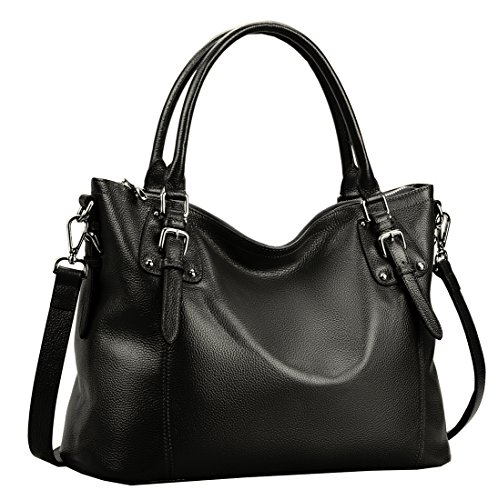
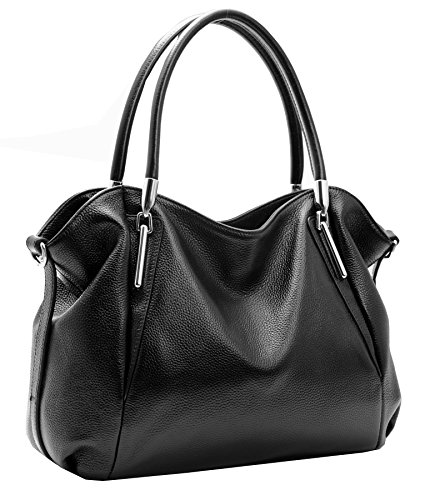
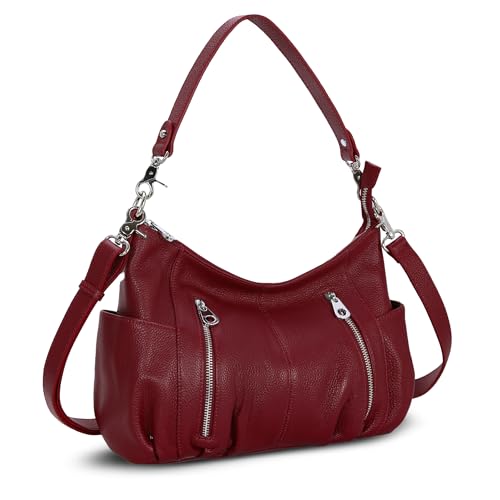
A tote measuring 14.96 by 4.72 by 11.81 inches gives you 834 cubic inches. It accommodates tall files because the walls rise straight from the base. Shoulder bags and top-handle bags with curved tops sacrifice their upper corners. A shoulder bag at 12.99 by 4.33 by 10.62 inches gives 597 cubic inches, but the effective packing height stops an inch below the zipper track.
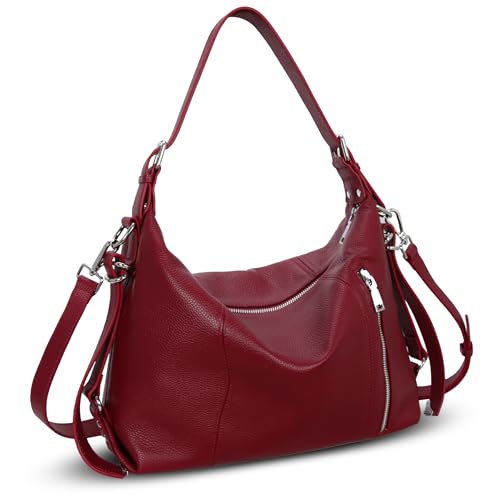
The shape of the base dictates stability. Flat bases fitted with four metal feet keep the lower leather clean and prevent the sides from collapsing outward when loaded. Softer shoulder bags slouch, which increases flexibility for odd items but reduces how neatly a flat tablet sits against the back panel.
Strap drop decides where the bag sits
Strap length changes how the weight hangs from your body. We cut detachable, adjustable straps that span ranges like 45.27 to 51.57 inches and 45.66 to 51.57 inches. A fixed top handle offers a short drop for hand carrying, while a long strap converts the piece for cross-body wear.
Check your own reach before settling on a strap range. Take a tape measure, loop it over your shoulder to your hip, and check where the top zipper lands. If the strap is too short, the upper rim crowds your armpit. If it is too long, the base bumps against your thigh as you walk.